Gymnastics Rings Olympics: The Test of Strength and Control
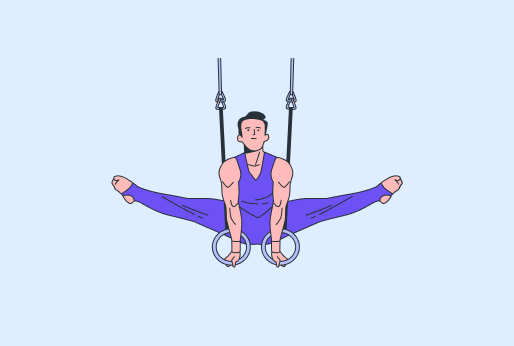
The gymnastics rings Olympics event, also called still rings, is the most demanding apparatus in men’s artistic gymnastics. Two rings hang from straps more than eight feet off the ground. They move with every tiny motion. Gymnasts must show superhuman upper body strength, perfect body control, and complete calm. No other event punishes small mistakes as hard as rings. Even a slight swing or bent arm costs big points. This is why gymnastics rings Olympics finals are always exciting and why the winners look almost superhuman.
Rings have been part of the Olympics since the first modern Games in 1896. Over the years, they have given us some of the most amazing moments in sports history. From the first iron cross in 1956 to the perfect routines we saw in Paris 2024, the gymnastics rings Olympics event keeps raising the bar for what humans can do with their bodies.
History of Rings in the Olympics
Rings started in the 1896 Athens Olympics. Back then, gymnasts did more swinging, almost like today’s horizontal bar. By the 1920s, the rules changed. Judges wanted more strength holds that stayed perfectly still. This created the modern still rings we know today.
The 1950s and 1960s belonged to Soviet and Japanese gymnasts. Albert Azaryan from the Soviet Union invented the famous iron cross (arms straight out to the sides while hanging). He won gold in 1956 and 1960. Everyone copied him after that.
In the 1980s and 1990s, Italy’s Jury Chechi ruled the event. People called him “The Lord of the Rings.” He won five world titles in a row and Olympic gold in 1996. China took over in the 2000s. Chen Yibing was unbeatable from 2006 to 2013 and won Olympic gold in 2008.
Today, Greece’s Eleftherios Petrounias and China’s Liu Yang are the top names. Liu Yang made history by winning gold in both Tokyo 2020 and Paris 2024. He is the first man to defend his Olympic rings title.
Rules and Scoring Explained Simply
A rings routine lasts about one minute. Gymnasts must show swing moves, strength holds, and a strong dismount. Judges give two scores:
- Difficulty score (D-score) – how hard the routine is
- Execution score (E-score) – how perfect it looks (starts at 10.0)
The rings must stay almost completely still during strength moves. Even small ring movement costs points. Arms must stay perfectly straight in crosses. Judges deduct 0.1, 0.3, or more for every mistake.
Top gymnasts today have D-scores around 6.8. That means they do many very hard moves. Liu Yang had the greatest difficulty in Paris 2024 with 6.8. The best execution score ever in the Olympics was 9.833 by China’s Zou Jingyuan.
The Hardest Moves in Gymnastics Rings Olympics History
The iron cross used to be the hardest move. Now almost every finalist does it. Today’s top moves include:
- Maltese cross (body completely flat, parallel to the floor)
- Inverted cross (hanging upside down with arms straight out)
- Azarian rolled into Maltese
- Triple twisting double back dismount
Gymnasts now connect several super-hard holds one after another without rest. This was impossible twenty years ago. Chinese and Japanese gymnasts keep pushing difficulty higher every four years.
Greatest Rings Gymnasts of All Time
Albert Azaryan (Soviet Union) – Created the iron cross, won gold in 1956 and 1960.
Jury Chechi (Italy) – Five straight world titles, Olympic champion 1996. Came back from a serious injury.
Chen Yibing (China) – Never lost a major competition from 2006 to 2011. His 2008 Beijing routine is still called perfect.
Eleftherios Petrounias (Greece) – Won five world titles and Olympic gold in 2016. Known for perfect form.
Liu Yang (China) – Current king. Won gold in 2020 and 2024. First to defend the Olympic rings title.
These men spent their whole lives training for 60 seconds on the rings every four years.
How Olympic Rings Gymnasts Train
Top ring specialists start training when they are very young. Chinese gymnasts begin rings work at age 8-10. By their teens, they train 6-8 hours every day.
They focus on straight-arm strength. This means building huge shoulders, chest, back, and core while keeping arms locked straight. They practice holds with extra weight (20-40 kg added during the iron cross).
They also do thousands of muscle-ups, hours of hold practice, and special exercises to keep the rings perfectly still. Most Olympic rings gymnasts can:
- Hold an iron cross with a 40 kg extra weight
- Do 15-20 muscle-ups without rest
- Hold the Maltese cross for 5-10 seconds
- Do planche (body flat like a plank while on rings) for 30+ seconds
This training takes 10-15 years of daily work.
Why Rings Are So Much Harder Than Other Events
The rings are not fixed like bars or a pommel horse. They can move in every direction. This makes everything ten times harder. Gymnasts must use tiny muscles to keep the rings still while holding their whole body weight.
During a Maltese cross, each shoulder carries more than 300 kg of force. That’s why rings specialists have the biggest upper bodies in gymnastics. Their shoulders and arms look carved from stone.
The rings hang 2.8 meters from the floor and are only 50 cm apart. This narrow distance makes strength moves much harder than on wider CrossFit rings.
How to Watch Gymnastics Rings Olympics from Anywhere
The next gymnastics rings Olympics will be in Los Angeles in 2028. Many fans already plan to watch every session live.
If you travel or live outside your home country, some streams may be blocked. A good VPN solves this problem easily. iProVPN lets you connect to servers in your home country and watch exactly as if you were there. It has fast speeds, perfect for HD and 4K streaming.
Many gymnastics fans use iProVPN to access different countries’ broadcasts. Japanese and Chinese coverage often shows better slow-motion replays and technical details.
Olympic Rings vs Regular Gym Rings
Real Olympic rings are very different from rings in most gyms:
- Made of wood, exactly 28 mm thick
- Only 50 cm apart (very narrow)
- Hang from special straps that move just the right amount
- Set 2.8 meters high
Most gym rings are plastic, thicker, and wider apart (55-60 cm). This makes moves much easier. A muscle-up on CrossFit rings feels easy compared to competition rings.
Even strong CrossFit athletes often can’t hold a proper support position on real Olympic rings. The difference is huge.
What Comes Next: Los Angeles 2028 and Beyond
The new rules for 2025-2028 allow even harder moves. Some gymnasts already train Maltese with full turns. Difficulty scores may soon reach 7.0 or higher.
Many people want women to compete on the rings, too. Female gymnasts like Simone Biles already train on rings for strength. Several countries want to add women’s rings by 2032 or sooner.
The future of gymnastics rings in the Olympics looks very exciting.
FAQs
The name means the rings must stay perfectly still during strength holds. Swinging is allowed only to connect moves, but the main focus is perfect stillness.
The Maltese cross is the hardest strength hold. When gymnasts connect it with other moves (like rolling into it), it becomes extremely difficult.
Women's gymnastics has different events (vault, bars, beam, floor). But many female gymnasts train on rings for strength, and some can do iron crosses. Change may come soon.
Albert Azaryan (1956, 1960), Akinori Nakayama (1968, 1972), and Liu Yang (2020, 2024) all have two gold medals each.
Most are 160-170 cm tall and weigh 58-68 kg. This size gives the best strength-to-weight ratio. Bigger gymnasts struggle more with bodyweight holds.
Yes, but it takes many years. With good training, strong adults can learn muscle-ups in months, iron cross in 3-5 years, and Maltese in 8-10 years. But it needs perfect coaching and patience.
Why is it called “still rings” when they swing sometimes?
What is the hardest move on rings?
Why don’t women compete on rings in the Olympics?
Who has won the most Olympic gold medals?
How big are Olympic rings for gymnasts?
Can normal people learn Olympic rings moves?
Final Thoughts!
Gymnastics rings at the Olympics are special because they show pure strength in its most beautiful form. No running start, no momentum, no tricks. Just you, two rings, and gravity. For sixty seconds every four years, the best gymnasts in the world make their bodies do things that seem impossible. They hold perfect positions while every muscle shakes. They make the rings stay perfectly still while hanging in shapes that are too painful to even look at.
This is why the ring finals are always magical. The crowd goes completely quiet. Everyone knows they are watching something very rare: humans pushing their bodies to the absolute limit. Whether you have followed gymnastics for years or just discovered it, the gymnastics rings Olympics event will always amaze you. It reminds us what years of hard work, pain, and dedication can create.
Los Angeles 2028 is coming soon. A new group of gymnasts is already training in gyms right now. They wake up at 5 AM every day and do thousands of pulls and holds. They dream of standing on that Olympic podium with a gold medal around their neck. The rings are waiting.
iProVPN encrypts your data for protection against hackers and surveillance. Unblock your favorite streaming platforms instantly with the best VPN for streaming.
Start Browsing Privately!